
Why Healthcare Costs So Much — Part 1 of 4
The Drug Pricing Machine
PBMs, Rebate Walls, and the Fight for Affordable Medication
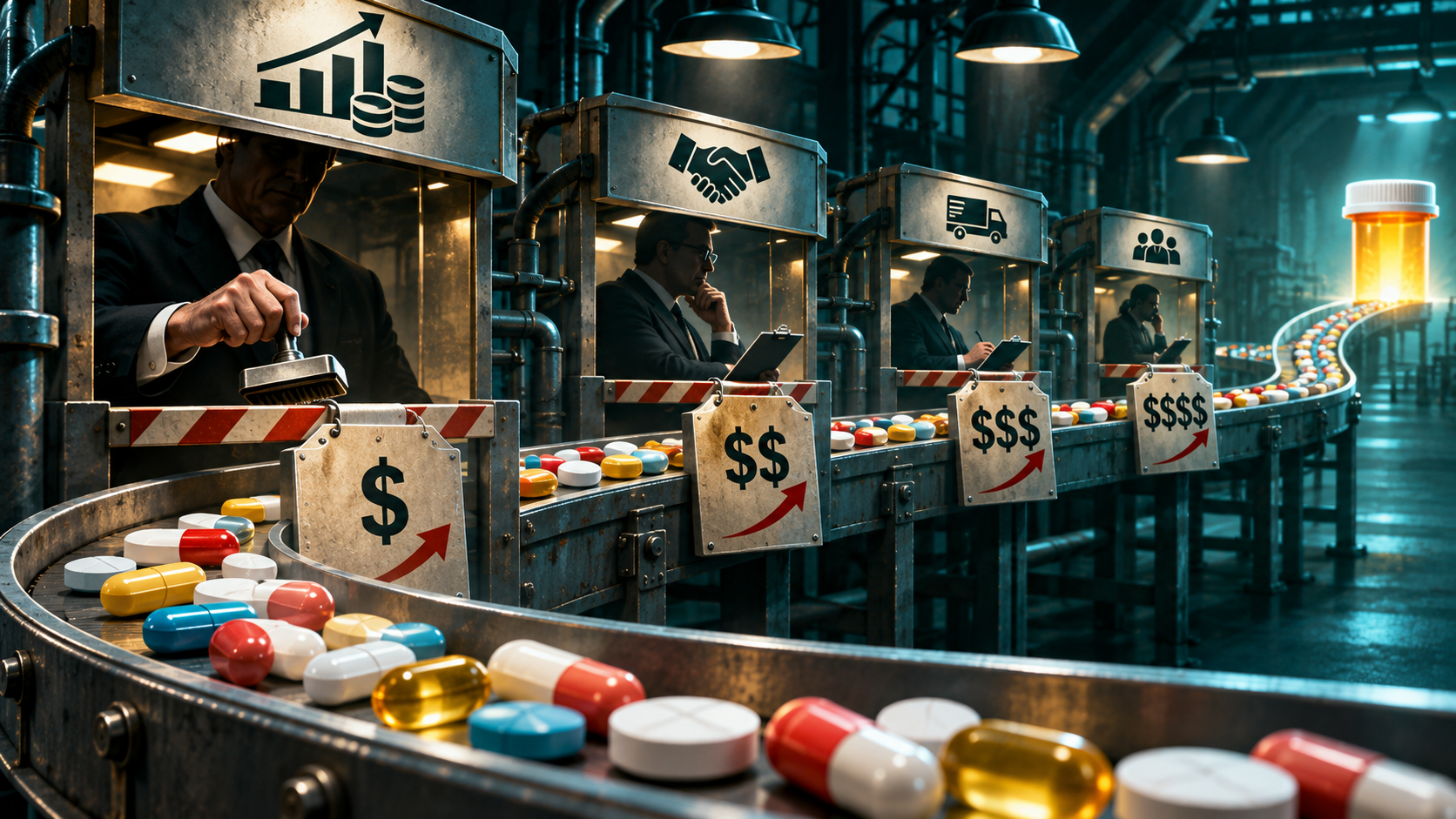
Image: AI-generated for CardioAdvocate
This article is for educational purposes only and does not constitute medical, legal, or financial advice. Drug pricing and healthcare policy are rapidly evolving; legislation and market dynamics described here reflect conditions as of October 2026. Consult your healthcare provider regarding medication decisions and your pharmacist or benefits administrator regarding insurance coverage and drug costs.
Americans spend more on prescription drugs than any other nation on earth — and it isn't close.
In 2022, the United States spent an estimated $5,244 per capita on pharmaceuticals, compared to roughly $1,400 in the United Kingdom and $1,800 in Germany. A RAND Corporation analysis found that U.S. drug prices are, on average, 2.78 times higher than prices in 33 other OECD nations. For brand-name drugs specifically, the ratio climbs to 4.22 times.
And no — it's not because Americans take more medication. OECD data on defined daily doses — the standard international measure of drug consumption — shows that U.S. per-capita utilization is comparable to or lower than many peer nations. A 2018 Health Policy study confirmed that the U.S. spending gap is driven by "higher transaction prices of medicines and the use of a more expensive mix of medicines" — not higher volume. Americans pay more per pill, not for more pills.
The total bill is staggering. U.S. healthcare spending reached $5.7 trillion in 2025 — roughly $17,000 per person, consuming nearly 18% of GDP. Prescription drugs account for approximately $400 billion of that, a number that has doubled in two decades.
Ask most Americans why drugs cost so much, and they'll point to "Big Pharma" — the manufacturers. That's part of the story. But there is another layer of the system that most patients have never heard of, one that operates largely out of public view, that may be doing more to inflate drug costs than the companies that actually make the pills.
They're called Pharmacy Benefit Managers — PBMs — and understanding what they do, how they profit, and whom they serve is the first step toward understanding why a vial of insulin that costs $8 to manufacture can carry a list price north of $300.
This is Part 1 of a four-part series examining why American healthcare costs what it does. We start here, with the drug pricing machine, because it's where the dysfunction is most visible — and where reform is finally, belatedly, beginning to bite.
The Middlemen You've Never Heard Of
A Pharmacy Benefit Manager (PBM) is a company that sits between you, your insurer, your pharmacy, and the drug manufacturer. If you have prescription drug coverage through an employer or health plan, a PBM is almost certainly managing it — deciding which drugs your plan covers, negotiating the prices, and processing every claim when you fill a prescription.
PBMs were created in the 1960s as simple claims processors — electronic clearinghouses that handled the paperwork of prescription drug benefits. Over the following decades, they evolved into something far more powerful. Today, PBMs perform three core functions:
1. Formulary Management: PBMs create and maintain the list of drugs your insurance will cover (the "formulary") and assign each drug to a tier that determines your copay. A drug on Tier 1 might cost you $10. The same drug on Tier 3 might cost $75. A drug not on the formulary at all? You pay full price.
2. Rebate Negotiation: PBMs negotiate rebates — essentially kickbacks — from drug manufacturers in exchange for favorable formulary placement. A manufacturer might pay a PBM a 30–50% rebate on a drug's list price to ensure it lands on Tier 2 instead of Tier 3, or to keep a competitor off the formulary entirely. These rebates are the economic engine of the PBM industry, and they are the root of much of the dysfunction we're about to explore.
3. Claims Adjudication and Network Management: PBMs process prescription claims in real time, maintain networks of pharmacies, and set the reimbursement rates that pharmacies receive for each prescription they fill.
In theory, PBMs should function as purchasing agents — using their collective bargaining power to drive down drug prices for the insurers and employers that hire them. In practice, the system has evolved into something considerably more complicated, and considerably more profitable — for the PBMs.
The Big Three: A Market Cornered
Three PBMs control approximately 80% of the U.S. prescription drug market:
CVS Caremark — owned by CVS Health, which also owns Aetna (insurance) and CVS Pharmacy (retail pharmacy)
Express Scripts — owned by Cigna Group, which also operates Cigna health insurance and Evernorth health services
OptumRx — owned by UnitedHealth Group, which also runs UnitedHealthcare (the nation's largest insurer) and Optum (healthcare services)
Read that list again, slowly. Each of the three dominant PBMs is owned by a parent company that also runs a major health insurance operation and a pharmacy or healthcare services arm. This is vertical integration on a scale that would make John D. Rockefeller blush.
The conflict of interest is structural and unavoidable. When CVS Caremark negotiates drug prices, it is negotiating on behalf of Aetna's members while simultaneously deciding which drugs get filled at CVS pharmacies — pharmacies owned by the same parent company. When OptumRx manages a formulary, it is making coverage decisions for UnitedHealthcare members while routing prescriptions through Optum's own specialty and mail-order pharmacies.
The FTC has taken notice. In a landmark 2024 interim report, the agency found that the Big Three PBMs managed approximately $400 billion in drug spending for nearly 270 million Americans. The report concluded that this concentration of power, combined with vertical integration, created "perverse incentives" that could raise drug costs rather than lower them.
A second FTC interim report focused on specialty drug markups was even more damning. The agency found that the six largest PBMs marked up specialty drug prices by a median of 284% — sometimes as high as 900% — when dispensed through their affiliated specialty pharmacies. The excess revenue from these markups totaled an estimated $7.3 billion over a four-year period on just a handful of drug classes, including oncology drugs, immunosuppressants, and treatments for multiple sclerosis.
The Rebate Wall: How Cheaper Drugs Get Locked Out
Here is the perverse heart of the PBM business model: PBMs don't necessarily prefer cheaper drugs. They prefer drugs with bigger rebates.
A rebate is a payment from a drug manufacturer to the PBM (and, in theory, to the health plan) in exchange for formulary access. The rebate is calculated as a percentage of the drug's list price — the higher the list price, the larger the dollar value of the rebate. This creates an economic incentive structure that is precisely backwards from what patients need.
Consider a simplified example:
Drug A (incumbent brand): List price $500/month. Manufacturer pays a 60% rebate = $300 back to PBM/plan. Net cost: $200.
Drug B (new competitor): List price $150/month. Manufacturer offers a 20% rebate = $30 back to PBM/plan. Net cost: $120.
Drug B is genuinely cheaper — the net cost to the plan is lower. But the PBM's revenue from the Drug A rebate is ten times larger. Which drug do you think ends up on the formulary?
This is the "rebate wall" — a financial barrier that blocks cheaper drugs from formulary placement because they cannot generate the rebate revenue that incumbent, higher-priced drugs command. The wall doesn't just affect hypothetical drugs. It has real-world consequences that patients feel every day.
The Humira Case Study: $6 Billion in Blocked Savings
The most dramatic illustration of the rebate wall involves Humira (adalimumab), one of the best-selling drugs in pharmaceutical history. When Humira's patents began expiring, multiple biosimilar alternatives — essentially the biologic equivalent of generic drugs — entered the market at significantly lower prices.
In a functional market, these cheaper alternatives would have rapidly captured market share. That's not what happened.
AbbVie, Humira's manufacturer, had built an enormous rebate structure around the drug — reportedly offering rebates of 60–70% or more to PBMs. The company also allegedly tied Humira rebates to rebates on its newer drugs, Skyrizi and Rinvoq — meaning that a PBM that dropped Humira from its formulary risked losing favorable pricing on AbbVie's entire portfolio.
The result? By late 2024, biosimilars had captured less than 2% of the adalimumab market. The Biosimilars Council estimated that PBM rebate schemes cost patients and the healthcare system approximately $6 billion in lost savings. Multiple manufacturer biosimilars — including Hulio, Yuflyma, and Abrilada — were excluded from all three major PBMs' standard commercial formularies.
By 2025, the landscape shifted — but in a way that revealed another layer of the game. Instead of simply adding cheaper biosimilars, the Big Three PBMs introduced "white label" biosimilars produced through exclusive partnerships with select manufacturers. CVS Caremark partnered with Sandoz through its subsidiary Cordavis. Each PBM now offers its own curated adalimumab product — maintaining control over supply, pricing, and profit margins even as Humira itself exits formularies.
The patients who needed affordable adalimumab waited years for savings that the market should have delivered immediately. And when those savings finally arrived, they came through PBM-controlled channels that preserved the middlemen's cut.
Spread Pricing: The Hidden Markup
Spread pricing is one of the simplest — and most opaque — ways PBMs generate profit. Here's how it works:
When you fill a prescription, two financial transactions happen simultaneously. Your health plan pays the PBM a certain amount for that drug. The PBM then pays the pharmacy a different amount — often less. The PBM pockets the difference. That's the "spread."
Example: Your insurer pays the PBM $100 for a prescription. The PBM pays the pharmacy $20. The PBM keeps $80.
You, the patient, never see either number. Your insurer sees only what it paid. The pharmacy sees only what it received. The spread is invisible to everyone except the PBM.
State-level investigations have exposed the scale of this practice. Ohio's 2018 audit of its Medicaid managed care program found that PBMs were charging the state $224 million more per year than they were paying pharmacies — a spread of roughly 9% across all prescriptions, with some generic drugs marked up by 300% or more. The findings were so alarming that Ohio passed legislation banning spread pricing in its Medicaid program.
Multiple states have since followed suit, and the FTC's 2024 report identified spread pricing as a key area of concern, noting that the practice creates a direct incentive for PBMs to steer patients toward drugs with the largest spreads rather than the lowest costs.
DIR Fees: Death by a Thousand Clawbacks
If spread pricing squeezes pharmacies from the front, Direct and Indirect Remuneration (DIR) fees squeeze them from behind.
DIR fees are retroactive charges that PBMs impose on pharmacies — often months after a prescription has been filled and the patient has walked out the door. They are nominally tied to "performance metrics," but the metrics are set by the PBMs themselves, and pharmacies have little ability to predict or contest the amounts.
The impact on independent pharmacies has been devastating. A pharmacy fills a prescription, receives its initial reimbursement, and then months later gets a bill from the PBM clawing back a portion of that payment. The pharmacy has already purchased the drug from its wholesaler, already paid its staff, already dispensed the medication. The clawback is pure loss.
According to the National Community Pharmacists Association, independent pharmacies have been closing at an accelerating rate — roughly 7.5 pharmacies per week in recent years. While multiple factors contribute to these closures, DIR fees are consistently cited as a primary driver. In rural communities, where an independent pharmacy may be the only one within a 30-mile radius, these closures create genuine healthcare deserts.
The Inflation Reduction Act's Medicare reforms eliminated retroactive DIR fees in Medicare Part D starting in 2024, requiring them to be applied at the point of sale instead. This was a meaningful improvement — but it applies only to Medicare, leaving the commercial market largely untouched.
The Reckoning: FTC, Insulin, and the Beginning of Accountability
For decades, PBMs operated in a regulatory blind spot — too powerful to ignore, too complex for most lawmakers to understand, and too deeply embedded in the healthcare system for easy reform. That changed in 2024.
In September 2024, the Federal Trade Commission filed an administrative complaint against all three major PBMs — CVS Caremark, Express Scripts, and OptumRx — alleging that their rebate practices had artificially inflated the price of insulin. The complaint charged that PBMs had systematically favored insulin products with higher list prices and correspondingly higher rebates, even when lower-priced alternatives were available.
Insulin was the perfect test case. The drug has been around for over a century. Its manufacturing cost is low — estimates range from $2 to $8 per vial. Yet U.S. list prices had climbed to $300 or more per vial, with the three major insulin manufacturers (Eli Lilly, Novo Nordisk, and Sanofi) and three major PBMs locked in what critics described as a "rebate spiral" — manufacturers raising list prices to fund larger rebates, which PBMs demanded in exchange for formulary access, which required higher list prices to fund larger rebates.
The complaint alleged that PBMs had excluded or disadvantaged lower-list-price insulins, pressuring manufacturers to keep list prices high. For patients with high deductibles or coinsurance — who pay a percentage of the list price, not the net price — this meant paying dramatically more out of pocket than the drug's actual cost justified.
By June 2026, all three PBMs had settled with the FTC. The specific settlement terms varied, but each included provisions requiring greater transparency in rebate practices and restrictions on the use of formulary exclusion as a tool to favor high-list-price products.
Congressional Reform: The CAA of 2026
The legislative branch finally acted as well. The Consolidated Appropriations Act of 2026, signed on February 3, 2026, included the most significant PBM reform legislation in U.S. history:
100% Rebate Pass-Through — For ERISA-governed employer plans (covering the majority of commercially insured Americans), PBMs must now pass through 100% of manufacturer rebates to the health plan. The days of PBMs retaining a slice of every rebate as profit are, at least for these plans, over.
Medicare Part D Delinking — Beginning January 2028, Medicare Part D reimbursement will be delinked from list prices. This dismantles the rebate spiral for the Medicare population — PBMs will no longer profit from higher list prices in the program that covers 65 million Americans.
Transparency Requirements — New reporting obligations require PBMs to disclose rebate amounts, spread pricing margins, and fee structures to plan sponsors.
The law also included provisions for pharmacy "any willing provider" protections, limiting PBMs' ability to steer patients away from independent pharmacies and toward their own affiliated pharmacy chains.
These are real reforms with real teeth. But they took decades to pass, and significant gaps remain — state-regulated plans, the individual market, and much of the specialty drug ecosystem remain only partially addressed. As one health policy analyst noted: this is the beginning of PBM reform, not the end.
Medicare Finally Gets to Negotiate
For most of its existence, Medicare was prohibited by law from negotiating drug prices — an extraordinary restriction that meant the single largest purchaser of prescription drugs in the country had to accept whatever price manufacturers set. The Veterans Affairs system, Medicaid, and even the governments of every other developed nation negotiated; Medicare could not.
The Inflation Reduction Act (IRA) of 2022 changed that. For the first time, Medicare was authorized to directly negotiate prices on a select group of high-cost drugs. The first round targeted 10 medications — including Eliquis (apixaban), Jardiance (empagliflozin), Xarelto (rivaroxaban), Entresto (sacubitril/valsartan), and Januvia (sitagliptin) — drugs that collectively accounted for billions in Medicare Part D spending.
The negotiated prices, announced in August 2024 and taking effect January 2026, delivered discounts of 38% to 79% off list prices. The Congressional Budget Office projected savings of approximately $6 billion in the first year alone.
For cardiologists and their patients, the impact was immediate. Eliquis — the most widely prescribed anticoagulant in the country, used by millions of patients with atrial fibrillation — saw its negotiated price drop by roughly 56%. Entresto, the cornerstone of modern heart failure therapy, was discounted by 53%. Jardiance, which carries indications for both diabetes and heart failure, was reduced by 66%.
For SGLT2 inhibitor prescribers, the numbers deserve a closer look. Jardiance — which carries FDA indications for type 2 diabetes, heart failure, and chronic kidney disease — was negotiated down to approximately $197 per month, from a list price north of $570. Farxiga (dapagliflozin), with a similar multi-indication profile, came in at roughly $178.50 per month, down from over $550. For Medicare beneficiaries, these are transformative reductions in the cost of drugs that prevent hospitalizations, slow kidney disease progression, and reduce cardiovascular death.
But the IRA didn't stop at negotiation. Two other provisions quietly changed the affordability landscape for millions of seniors:
The $2,000 Out-of-Pocket Cap — Beginning in 2025, Medicare Part D beneficiaries pay no more than $2,000 per year in total out-of-pocket drug costs. Before this cap, patients in the coverage gap could face thousands in annual spending. An estimated 3.2 million Medicare enrollees benefit from this protection.
The $35 Insulin Cap — Medicare beneficiaries now pay no more than $35 per month for covered insulin products, regardless of the number of prescriptions. For the roughly 3.4 million Medicare beneficiaries who use insulin, this eliminated the nightmare of choosing between rent and a drug that costs $8 to manufacture.
The second round of negotiations targets 15 additional drugs — including Ozempic and Wegovy (semaglutide) — for prices effective in January 2027. A third round — 15 more drugs, including Part B medications — will follow for 2028.
The pharmaceutical industry has challenged these negotiations in court, arguing they constitute unconstitutional "compelled speech" and violate due process. As of mid-2026, multiple federal courts have rejected these challenges. The program is proceeding.
Taken together, the IRA's drug provisions represent the most significant expansion of medication affordability for seniors since Medicare Part D was created in 2003. For the 65-and-over population, the system genuinely improved.
The question is what happened next — and who got left behind.
The Access Paradox: The Drug Got Cheaper — The Door Got Narrower
Here is the part of the story that doesn't fit neatly into anyone's political narrative.
In April 2025, the current administration signed Executive Order 14273, directing the Department of Health and Human Services to continue IRA drug price negotiations and address the so-called "pill penalty" — the disparity in Medicare cost-sharing between physician-administered drugs (Part B) and oral medications (Part D) that can make a pill more expensive to the patient than an infusion of the same drug class. The administration publicly claimed credit for the negotiated price reductions that took effect in January 2026 — reductions that were, in fact, the product of legislation passed three years earlier under the previous administration and negotiations conducted by career CMS officials.
Independent fact-checkers noted the disconnect. But credit-claiming is bipartisan sport, and in isolation it would be a footnote. What matters — what affects patients — is what happened alongside the price reductions.
The Medicaid Cuts
On July 4, 2025, the President signed a reconciliation bill that included approximately $700 billion in Medicaid cuts over a decade — the largest reduction in safety-net healthcare spending in American history. Work requirements, redetermination acceleration, and per-capita cap structures were projected to result in millions of Americans losing coverage. The Senate version of the bill, still being negotiated in early 2026, proposed cuts exceeding $1 trillion.
The Senate version also dropped most of the drug-pricing provisions that the House had included — including expanded negotiation authority and commercial market reforms — retaining only a narrow fix for orphan drug exclusions. In other words: the same legislative vehicle that could have extended IRA-style affordability protections to the under-65 population was used instead to shrink the safety net that many of those patients depend on.
Think about what this means in practice. The Medicare population got genuinely cheaper SGLT2 inhibitors. But the Medicaid population — lower-income patients with higher rates of diabetes, heart failure, and CKD, and who are disproportionately Black and Hispanic — faced the prospect of losing drug coverage entirely. The door to the pharmacy didn't just stay narrow. For millions of patients, it started closing.
The SGLT2 Inhibitor Case Study: A Drug That Works — When Patients Can Get It
SGLT2 inhibitors are, by any evidence-based measure, among the most important cardiovascular drugs developed in the last two decades. They reduce cardiovascular death, prevent heart failure hospitalizations, slow progression of chronic kidney disease, and improve glycemic control — all in a single oral medication. Guidelines from the ACC/AHA, ADA, and KDIGO recommend them across multiple indications.
For Medicare patients, the IRA made these drugs meaningfully more affordable. For everyone else, affordability depends on the same system this article has been describing — and the system is not cooperating.
Consider the commercial insurance landscape:
~40% of commercially insured lives face step therapy or prior authorization requirements before an SGLT2 inhibitor prescription can be filled.
A 2024 study found that prior authorization delays for SGLT2 inhibitors led to a two-fold increase in patients who never received the drug at all — not delayed, but never treated.
Black and Hispanic patients were disproportionately affected — reflecting well-documented disparities in insurance coverage, pharmacy access, and the administrative burden of navigating prior authorization systems.
Cash prices without insurance: $550–$900 per month for brand-name empagliflozin or dapagliflozin.
There is a genuine bright spot: generic dapagliflozin launched in April 2026, bringing the first generic SGLT2 inhibitor to market. Early cash prices have dropped significantly — a development that, over time, should improve commercial access independent of insurance negotiations. But generic availability doesn't eliminate prior authorization requirements, doesn't help patients who've already lost Medicaid coverage, and takes time to filter through formulary decisions.
The pattern that emerges is not subtle. Medicare negotiation made SGLT2 inhibitors affordable for seniors. A generic is beginning to help the commercially insured. But the population in between — too young for Medicare, too poor to pay cash, dependent on Medicaid — is the population being squeezed by coverage cuts at the exact moment these drugs became both cheaper and more evidence-based than ever.
A drug that costs $197 per month is meaningless if you no longer have insurance. A negotiated price is irrelevant if prior authorization means you never get the prescription filled. The access paradox is this: America finally figured out how to make these drugs affordable, and then made it harder for the most vulnerable patients to reach them.
Mark Cuban's Radical Experiment: What If We Just... Showed the Price?
In January 2022, billionaire entrepreneur Mark Cuban launched Cost Plus Drugs with a premise so simple it was almost absurd: buy generic medications at their actual manufacturing cost, add a transparent 15% markup, charge a $3–5 pharmacy labor fee and a $5 shipping fee, and show the entire breakdown to the customer.
No rebates. No spread pricing. No hidden fees. No formulary games. Just the drug, its real cost, and a modest, disclosed margin.
The price differences are sometimes jaw-dropping:
Imatinib (generic Gleevec, a leukemia drug): Retail price ~$2,500/month → Cost Plus price: ~$19
Abiraterone (prostate cancer): Retail price ~$6,140/month → Cost Plus price: ~$67
These aren't anomalies. The company now carries approximately 2,500 medications and has built its own manufacturing facility in Dallas, Texas.
The Cost Plus model has genuine limitations. It's primarily a mail-order pharmacy, which doesn't work for every patient or every medication. It carries mostly generics, not brand-name drugs (where the rebate game is most entrenched). A 2026 analysis in the American Journal of Managed Care found that Cost Plus beat commercial insurance copays about 80% of the time — but on low-cost generics already available cheaply at retail pharmacies, the per-prescription fees can actually make Cost Plus more expensive.
But the significance of Cost Plus isn't just in the savings it provides to individual patients. It's in what it reveals: that the gap between what a drug actually costs and what Americans are charged is not a natural feature of the market. It's a consequence of a system designed to obscure prices, reward opacity, and profit from complexity.
When you can buy the same generic drug for $19 through a transparent model that someone is buying at $2,500 through the PBM-rebate system, the system is not working. It is working as designed — and the design serves the middlemen, not the patients.
Cuban has been characteristically blunt about this: "The entire PBM industry is built on opacity. Their margin is your misery."
The Affordable Drug Paradox: When Cheaper Means Excluded
The rebate wall doesn't just affect generics and biosimilars. It poses a structural challenge for any new drug that tries to come to market at an affordable price — because in the current system, affordable means low rebates, and low rebates mean poor formulary access.
Consider the challenge facing NewAmsterdam Pharma, a company developing obicetrapib, a next-generation CETP inhibitor for LDL cholesterol lowering. In SEC filings, the company has stated that obicetrapib's low manufacturing cost should enable "favorable pricing" — language that signals an intention to price below existing branded LDL-lowering therapies like PCSK9 inhibitors (which carry list prices of $5,000–$14,000 per year).
The intention is laudable. But here's the trap: if obicetrapib launches at, say, $2,000/year when competitors are listed at $10,000/year, the competitors can offer PBMs rebates of 60–70% (yielding $6,000–$7,000 per patient in rebate revenue) while obicetrapib's rebate on a $2,000 price — even at the same percentage — generates a fraction of that amount. The PBM's financial incentive is to keep the expensive drug on the formulary and exclude the affordable one.
This isn't a theoretical concern. It's the same dynamic that delayed biosimilar adoption for Humira, and it's the reason that health policy experts describe the rebate system as a "tax on affordability" — a system that punishes companies for pricing their drugs reasonably.
We don't yet know how obicetrapib's U.S. pricing and formulary access will play out — the drug is still awaiting regulatory decisions in Europe (expected in the second half of 2026) and has not yet announced a U.S. launch price. But the structural challenge it faces illustrates a fundamental dysfunction: in the current PBM system, a drug can be too cheap to succeed.
What This Means When You're the Patient
The consequences of this system are not abstract. They are measured in patients who ration insulin because they can't afford the copay. They are measured in cancer patients who delay treatment while navigating prior authorization requirements. They are measured in the rural communities that lose their only pharmacy because DIR fee clawbacks made the business unsustainable.
A few numbers that put the patient impact in perspective:
Medication non-adherence due to cost affects an estimated 8% of American adults — roughly 20 million people who skip doses, split pills, or don't fill prescriptions because of out-of-pocket costs. In cardiovascular medicine, non-adherence to statins, antihypertensives, and anticoagulants directly translates to increased rates of heart attacks, strokes, and death.
The deductible trap is particularly cruel. A patient with a $3,000 deductible pays 100% of drug costs until that threshold is met. Because the cost counted against the deductible is based on the list price (before rebates), the patient effectively subsidizes the rebate system during the months they're paying out of pocket. The rebate goes to the PBM and the plan; the patient pays the inflated list price.
Prior authorization — the requirement that a PBM approve a prescription before it's covered — has become one of the most common sources of treatment delay in American medicine. An American Medical Association survey found that 94% of physicians reported care delays associated with prior authorization, and 33% reported that prior authorization had led to a serious adverse event for a patient in their care.
For cardiometabolic patients specifically, the stakes are particularly high. The drugs at the center of this system — statins, PCSK9 inhibitors, SGLT2 inhibitors, GLP-1 receptor agonists, anticoagulants — are not optional luxuries. They are medications that prevent heart attacks, strokes, kidney failure, and death. When the pricing system makes these drugs inaccessible, people die. It is that straightforward.
Why Only Here? The International Perspective
The PBM model is a uniquely American phenomenon. No other developed country uses private, for-profit intermediaries to manage drug pricing in this way. Here's why U.S. drug costs are outliers:
Every other developed nation negotiates drug prices directly. The UK's National Institute for Health and Care Excellence (NICE) evaluates drugs based on cost-effectiveness and negotiates prices with manufacturers. Canada's Patented Medicine Prices Review Board caps prices. Germany allows free pricing at launch but mandates negotiation after one year. Japan sets prices through a government-administered schedule. In each case, a government entity serves as the counterparty to the drug manufacturer — not a profit-seeking intermediary.
The result: the same drugs, made by the same companies, sold to the same patient populations, cost two to four times more in the United States.
The common defense of this disparity goes something like this: other nations freeload off American innovation. Their government price controls suppress what manufacturers can charge, so pharmaceutical companies must recoup their R&D costs in the one market that still pays — the U.S. Under this view, American patients are subsidizing the world's medicines, and that's the price of capitalism working as intended.
There is a grain of truth in this argument — and a mountain of misdirection. An NBER working paper by Frech, Pauly, and colleagues estimated that the United States provides roughly 73% of the worldwide financial incentive for pharmaceutical innovation, with the rest of the world contributing about 27%. The U.S. market is, indisputably, where the money is.
But here's what the "subsidizing innovation" narrative leaves out. A 2019 Health Affairs study of 15 major pharmaceutical companies found that U.S. revenue premiums over other countries totaled approximately $116 billion per year. Of that, only about 66% went back into R&D. The rest went to profits, stock buybacks, executive compensation, and marketing — the last of which, at roughly $30 billion per year, actually exceeds what many companies spend on research.
More fundamentally, the pricing gap between the U.S. and the rest of the world is not a story about manufacturers charging what they need to fund research. Pharmaceutical companies are profitable in every major market. Novo Nordisk is not a charity in Denmark. Roche is not struggling in Switzerland. AstraZeneca turns a profit in the UK. What differs is not whether manufacturers get paid — it's how many hands the money passes through before reaching them. The U.S. doesn't have a free market for prescription drugs. It has the most intermediated market in the world — and the intermediaries are the ones charging admission.
When a PBM retains a share of a manufacturer rebate, marks up a specialty drug by 284%, or pockets an $80 spread on a generic prescription, that money doesn't fund a single clinical trial. The middlemen are extracting from the system on top of whatever the manufacturer charges — and none of it goes to R&D. The innovation subsidy argument, even where it applies to manufacturer pricing, has nothing to do with PBM profits.
The Innovation Pipeline: Cutting the Roots While Defending the Fruit
If the defense of high U.S. drug prices rests on America's role as the world's pharmaceutical innovator, that defense is developing a serious crack — not from the pricing system, but from the other end of the pipeline.
The vast majority of breakthrough drugs don't begin in a pharmaceutical company's lab. They begin in university research centers, funded by the National Institutes of Health (NIH). A landmark PNAS study found that NIH-funded research contributed to the published science behind every single one of the 210 new drugs approved by the FDA from 2010 to 2016 — and more than 90% of that funding supported basic research, the foundational science that identifies drug targets long before a pharmaceutical company begins clinical trials. A separate JAMA Health Forum analysis confirmed the pattern across 387 drugs approved through 2019.
This is the pipeline that is now being dismantled.
In 2025 and 2026, sweeping disruptions to NIH funding — including mass grant terminations, a controversial forward-funding mechanism that reduces the number of new awards, and proposed budget cuts of up to 40% — have thrown the U.S. biomedical research enterprise into crisis. By mid-fiscal year 2026, the NIH had awarded 74% fewer competitive grants than the average for the same period in prior years. Grant success rates have fallen to approximately 17% — the lowest in nearly three decades. Thousands of mid-research grants have been terminated early.
The effects are not theoretical. University cardiology and cardiovascular research programs — the same labs that produced the foundational science behind SGLT2 inhibitors, PCSK9 inhibitors, and GLP-1 receptor agonists — are losing funding, laying off researchers, and shelving projects. When NIH grants dry up, they don't just pause research — they dismantle teams. A postdoctoral researcher who leaves for industry or another country doesn't come back when the grant resumes. The institutional knowledge walks out the door.
This creates a bitter irony at the heart of the drug pricing debate. The argument that Americans must pay more for drugs to fund innovation rings hollow when the same political system that defends high drug prices is simultaneously defunding the basic research that produces the innovations. You cannot claim that high prices are justified by America's role as the world's pharmaceutical innovator while cutting the roots of that innovation. The pharmaceutical industry doesn't fund basic science — it commercializes basic science. And basic science runs on NIH grants.
If the current trajectory continues, the U.S. won't just lose its position as the global leader in biomedical research. It will have created the worst of both worlds: the highest drug prices in the world and a declining research pipeline. Americans will still be subsidizing something — just not innovation.
In Fairness: What PBMs Get Right
It would be intellectually dishonest to paint PBMs as purely parasitic. They do serve real functions:
Aggregate purchasing power. By pooling millions of covered lives, PBMs can negotiate prices that no individual employer or patient could achieve alone. This is genuine value — and for some drug classes, particularly commoditized generics, the competition among PBMs does produce lower costs.
Utilization management. PBMs implement drug utilization review, step therapy protocols, and formulary tiering that can steer prescribing toward clinically equivalent but less expensive options. When done well, this is evidence-based cost management. When done poorly, it's a prior authorization nightmare that delays care.
Administrative infrastructure. The real-time claims processing network that PBMs operate is genuinely complex and genuinely necessary. Someone has to adjudicate the 6.7 billion prescriptions Americans fill each year. PBMs do this efficiently.
The question isn't whether PBMs provide any value. It's whether the value they provide is worth the cost they impose — and whether a system this concentrated, this opaque, and this conflicted can ever truly serve patients' interests. The FTC's findings, the insulin settlements, and the legislative reforms of 2026 all suggest that the answer, for now, is no.
THE BOTTOM LINE
The U.S. drug pricing system is not broken. It is functioning exactly as its incentive structures predict — rewarding opacity, punishing affordability, and concentrating profit in a layer of intermediaries that most patients don't know exist.
PBMs began as simple claims processors and evolved into vertically integrated conglomerates controlling $400 billion in drug spending for 270 million Americans. Their rebate-based business model creates a financial incentive to prefer expensive drugs over cheap ones, to block affordable competitors, and to extract value at every transaction between the manufacturer and the patient.
Reform is underway — the FTC's enforcement actions, the CAA 2026 reforms, Medicare price negotiation, and transparent pricing models like Cost Plus Drugs all represent meaningful progress. But the system evolved over decades, and it will not be dismantled in a single legislative session.
What you can do: Ask your pharmacist what your drug actually costs without insurance. Check costplusdrugs.com for your generic medications. Ask your employer's benefits team whether your PBM passes through 100% of rebates. Know your formulary — and know that being on a lower tier doesn't always mean the drug is cheaper, it means it's more profitable for someone in the chain. Your awareness is the first crack in the wall.
Why Healthcare Costs So Much
Part 1: The Drug Pricing Machine — You are here
Part 2: The Facility Fee Game — Coming soon
Part 3: Private Equity's Healthcare Play — Coming soon
Part 4: The Doctor Myth — Coming soon
Your heart doesn't care about your copay tier. Neither should your treatment.
— CardioAdvocate
CardioAdvocate provides medical education content for informational purposes only. This article does not constitute medical, legal, or financial advice. Healthcare policy and drug pricing are complex and evolving — specific details may change after publication. Always consult qualified professionals for medical, legal, and financial decisions. CardioAdvocate has no financial relationship with Mark Cuban Cost Plus Drugs, NewAmsterdam Pharma, or any PBM. © 2026 CardioAdvocate. All rights reserved.
